


Do Schools Need Fire Resistant Noticeboards? BB100 Guide

Do Schools Need Fire Resistant Noticeboards?
Yes, in the places that matter most. Corridors, stairwells, lobbies and escape routes usually require fire-rated display surfaces to meet building-regulation fire-safety expectations, while classrooms generally do not. This guide covers what BB100 says, where Class B boards are required, and the mistakes that catch schools out.
Arson is a real risk in schools: BB100 reports around 1 in 20 has a fire each year, and nearly 60% are started deliberately. Boards lined with paper add fuel right where people need to escape, so escape-route surfaces are held to a higher standard.
What Is BB100?
BB100 is Building Bulletin 100, the Department for Education's fire-safety design guidance for schools, from nurseries to sixth forms. It is non-statutory, so not the law in itself: it sets good practice for limiting fire spread, including how noticeboards are sized, spaced and covered. The legal duties sit in the Building Regulations (Approved Document B) and the Regulatory Reform (Fire Safety) Order 2005.
Are Fire Resistant Noticeboards Mandatory?
Fire resistant noticeboards are usually needed in corridors, stairwells, lobbies and escape routes, and are generally optional in ordinary classrooms. No single law says every school must buy fire-rated boards; what the rules control is the reaction-to-fire performance of escape-route surfaces.
The responsible person, usually the headteacher or facilities manager, signs this off through the fire risk assessment.
Which Areas Need Fire-Rated Boards?
Corridors, stairwells, lobbies and escape routes usually need fire-rated boards; ordinary classrooms generally do not. If a space is part of how people leave the building, its walls are held to a higher standard.
| School area or location | Fire-rated noticeboard requirement |
|---|---|
| Corridors on escape routes | Fire-rated (Class B), covered, with breaks between boards |
| Stairwells and protected stairways | Fire-rated, glazed only. Open paper boards not permitted |
| Lobbies and reception escape routes | Fire-rated (Class B) |
| Dead-end corridors | Glazed Class 0 / Class B only. No open boards |
| Classrooms (not an escape route) | Standard boards generally acceptable, with sensible limits |
| Staff rooms and offices | Standard boards generally acceptable |
| Not sure, or a mixed-use room | Ask the fire risk assessor and choose Class B as the safer default |
Where a position is unclear, specify Class B and confirm with your fire risk assessor.
What Do Class 0, Class 1 and Class B Mean?
In corridors and escape routes, noticeboards should meet BS EN 13501-1 Class B, the reaction-to-fire classification used in Approved Document B for wall and ceiling linings. Three ratings come up when comparing products.
| Fire rating classification | What the fire rating means | Where it applies in schools |
|---|---|---|
| Class 0 (BS 476) | Former British Standard; top performance for wall and ceiling linings, with very limited surface spread of flame | Historically required in corridors and escape routes |
| Class 1 (BS 476) | Low surface spread of flame, one step below Class 0 | Open boards in some corridors with an alternative escape route, within strict area limits |
| Class B (BS EN 13501-1) | Current European reaction-to-fire classification in Approved Document B for wall and ceiling linings; replaces older national ratings such as Class 0 | The standard to specify now for corridors, stairwells and escape routes |
The key point: the rating must cover the whole board, both the surface fabric and the core behind it, not the fabric alone. A Class B board suits the positions where Class 0 was previously specified.
Open or Glazed Boards: Which Should Schools Use?
Use glazed or lockable boards on escape routes, and open boards in classrooms. The fire risk is mostly the paper, not the board, so how the paper is contained decides where a board can go.

- Quick to update, easy for pupil work
- Fine inside classrooms and staff rooms
- Restricted on escape routes, where exposed paper adds fuel

- Paper enclosed, so it cannot feed a fire
- Can meet corridor and stairwell requirements when the whole board is certified
- Lockable versions stop tampering and overfilling
For escape routes, a glazed or lockable noticeboard with a Class B interior keeps both the compliance and the tidy look. Open boards still suit classrooms.
What Does BB100 Say About Noticeboards?
BB100 keeps noticeboards on escape routes covered, short and spaced apart, so a fire cannot run along a wall. The detail matters before a corridor refit.
Common Mistakes Schools Make
- Assuming every board must be fire-rated. Standard boards are fine in ordinary classrooms; the rule bites on corridors, stairwells, lobbies and escape routes.
- Trusting fire-retardant fabric alone. The rating must cover the whole board. A treated felt face on an uncertified backing is not Class B.
- Overloading open boards in corridors. Layered paper is the fuel. On escape routes, use glazed or lockable boards and keep the paper enclosed.
- One long unbroken run of boards. BB100 expects breaks between boards and a cap on wall coverage, so flame cannot travel the full corridor.
- Treating BB100 as the law. BB100 is guidance; the legal duties sit in the Building Regulations and the Fire Safety Order.
- Keeping no certification. Without the Class B documentation on file, a board cannot be evidenced in the fire risk assessment.
How Do You Choose a Compliant Noticeboard?
Look for boards tested to BS EN 13501-1 Class B on both the fabric and the core, a non-combustible aluminium frame, and certification for your fire risk assessment. Displaysense boards are rated to Class B with that documentation, and school purchase orders are accepted on 30-day credit terms.
For corridors and escape routes, choose a certified Class B board sized to keep each run within BB100 spacing. The options below suit common school positions.

Best-selling large-format Class B board (NB4818GR) for main corridors and circulation walls.
View Board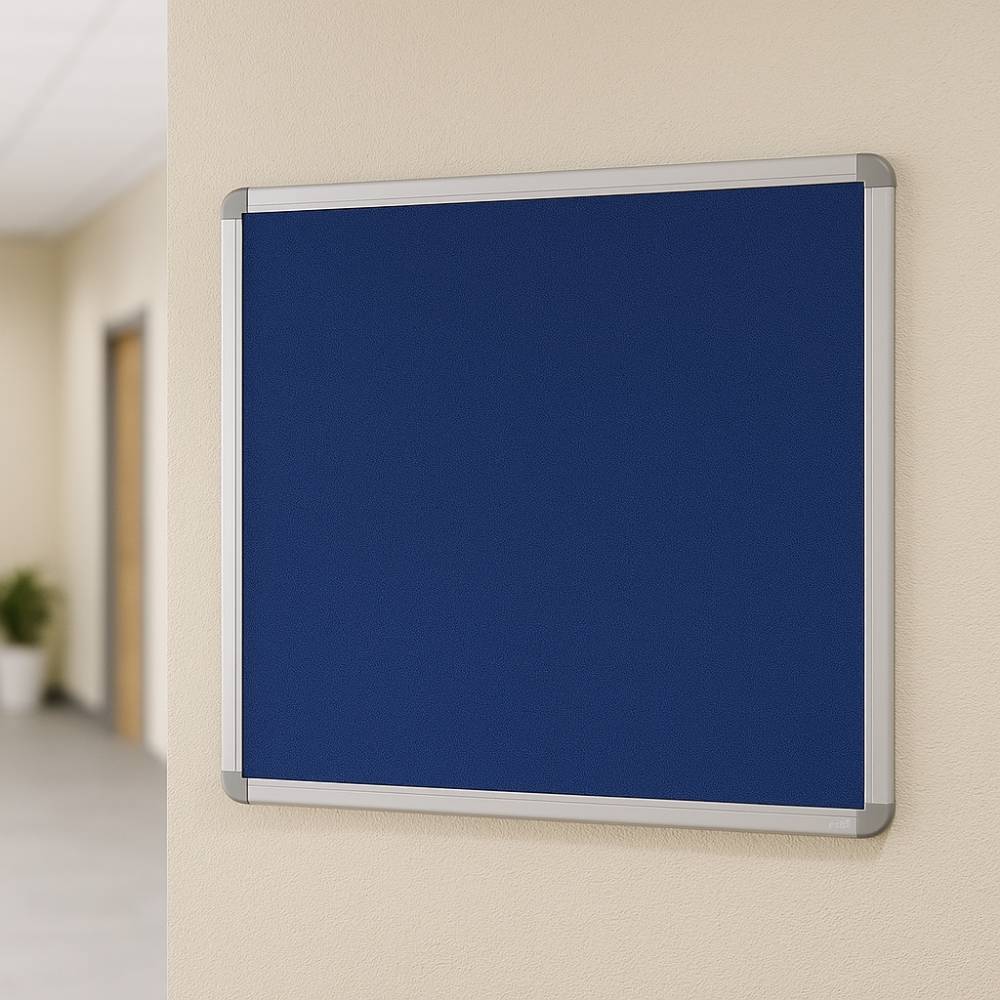
Compact Class B board (NB4806BL) for shorter corridor runs and entrance walls.
View Board
Tamperproof glazed board with a Class B interior, for controlled notices in public corridors.
View BoardBrowse the full range in the fire resistant boards collection, or see standard options in the noticeboards collection for classroom positions. For the wider institutional range, visit display and storage solutions for education.
Noticeboards in Real School Settings
Here are a few examples of boards in real school settings, from glazed boards on entrance and corridor escape routes to open boards inside classrooms.

A black-framed, glass-fronted board sits on a main thoroughfare, keeping notices enclosed where an open paper board would not suit an escape route.

A framed board beside the lockers carries information where pupils pause, with a solid frame that suits a busy circulation space.

Inside a classroom, away from escape routes, an open display board is fine for pupil work and is quick to change.

A glass-fronted board on a modern corridor keeps paper contained on a circulation route, the kind of position where a Class B, glazed board belongs.

A corridor board holds pinned information sheets at a glance. On an escape route, boards like this are kept short and spaced apart in line with BB100.
Displaysense supplies BS EN 13501-1 Class B fire-rated noticeboards with certification documentation, free UK mainland delivery, and purchase orders on 30-day credit terms for schools and colleges.
Schools usually need fire resistant noticeboards on escape routes, corridors, stairwells and lobbies, where surfaces should meet BS EN 13501-1 Class B; standard boards are generally fine in classrooms. Specify certified Class B for any corridor or stairwell, keep the certification on file, and confirm anything uncertain with your fire risk assessor.
Frequently Asked Questions
Do schools legally need fire resistant noticeboards?
What is BB100 for schools?
What is the difference between Class 0 and Class B noticeboards?
Are noticeboards allowed in school corridors?
Why are open noticeboards a fire risk in schools?
Where can I buy fire resistant noticeboards for schools in the UK?
This guide is based on the Department for Education's Building Bulletin 100 (BB100) fire safety guidance for schools, Approved Document B fire safety guidance, and the Regulatory Reform (Fire Safety) Order 2005. Following this guidance is generally accepted as one way to meet the regulations, but it does not guarantee compliance in every case. Schools should confirm the final specification with their fire risk assessor or responsible person.

Felt, lockable, fire-rated or outdoor? Match the right board to its use, location and who needs access.
What works in high-traffic corridors, from tamperproof boards to fire-rated options and sizing.

What to display in halls and on campus, including safety and escape-route information.
