


Cork Noticeboards









Recently Viewed
UK's Trusted Display and Signage Supplier · Since 1978
Cork Noticeboards:
Natural Pin Boards and Display Panels
Cork noticeboards have a natural cork surface bonded to a fibreboard backing, held in an anodised aluminium or wood frame. The cork granule structure is elastic: pin holes close when pins are removed, preventing the pitted and crumbly surface appearance that develops on dense foam and low-quality cork over time. Standard push pins, drawing pins, and thumbtacks all penetrate cleanly. Sizes from 900x600mm to 2400x1200mm. Portrait or landscape mounting from the same board. Concealed corner fixings for safe installation in school hallways and public areas. PO accepted from schools, NHS trusts, and universities on 30-day credit terms.
Cork is the traditional noticeboard surface for a reason. The elastic cell structure of natural cork allows pins to penetrate without tearing the material, and the material springs back to close the hole when a pin is removed. Over months of daily use in a busy staff room or classroom, a cork board maintains a clean flat surface; a dense foam board develops permanent indentations; a fabric board accumulates visible pin holes that do not close. For environments where the noticeboard is a permanent fixture used intensively over years, cork is the most durable open-surface pin board material.
Our cork noticeboard range includes aluminium-framed boards for corridors and classrooms, wood-framed boards for offices and professional environments, and large-format boards to 2400mm wide for staff rooms and project display. For corridors, stairwells, and fire escape routes, our fire-rated noticeboards are the compliant specification. For lockable secure display see our lockable noticeboards. For the full range see our noticeboards collection.
Cork
Why Choose Displaysense Cork Noticeboards
Self-Healing Cork Surface: Why It Stays Clean with Heavy Use
Natural cork is composed of millions of elastic air-filled cells that compress under a pin and spring back when the pin is removed, closing the hole. This is the self-healing property that distinguishes natural cork from dense foam and synthetic alternatives. A foam board develops permanent compressed indentations; a natural cork board closes after every pin removal. Over years of daily use in a classroom, staff room, or office the cork board maintains a visually clean surface while foam and low-quality synthetic boards develop an increasingly pitted and deteriorated appearance. The self-healing property is a structural characteristic of the natural material, not a surface coating.
Anodised Aluminium Frame Protects Cork Edges from Fraying
The exposed edges of a cork surface without framing crumble and fray with regular contact, particularly at corner positions where pin placement is concentrated. The anodised aluminium frame holds the cork to the fibreboard backing under compression at all four edges, preventing edge deterioration and maintaining the board's structural integrity over its working life. The anodised finish does not rust, chip, or require repainting. Wood-framed alternatives provide a warmer aesthetic for office and professional environments. Both frame types use the same concealed corner fixing system for wall mounting.
Concealed Corner Fixings for Safe School and Public Installations
Our framed cork boards use corner mounting brackets with clip-on covers that conceal the screw heads after installation. Exposed screw fixings on a noticeboard at child height in a school corridor present a snag and injury risk. Concealed fixings eliminate this risk and produce a cleaner wall installation appearance. The same fixing system is suitable for portrait or landscape orientation, allowing the board to be installed in either direction using the same hardware without additional components.
Renewable Natural Material with No Off-Gassing
Cork is harvested from the bark of cork oak trees, which regenerates without felling the tree. The harvesting cycle is typically 9 to 12 years per tree, making cork one of the most sustainable natural materials in commercial use. For schools, healthcare facilities, and workplaces with indoor air quality policies, cork is an appropriate specification because it contains no synthetic adhesives or volatile compounds that off-gas in enclosed rooms. Organisations with environmental procurement policies can specify cork noticeboards as a compliant natural material choice against synthetic foam or fabric alternatives.
900mm to 2400mm: From Desk-Side to Staff Room Scale
Our cork noticeboard range covers 900x600mm for compact office and home office positions, through standard institutional sizes at 1200x900mm and 1800x1200mm, to large-format 2400x1200mm boards for staff rooms, project display, and large open-plan positions. The high-density cork and reinforced fibreboard backing on larger boards prevents warping across the full width, a common failure mode on cheaper large-format boards where the unsupported backing bows away from the wall over time.
Portrait or Landscape Mounting from the Same Board
The symmetrical frame and corner fixing system allows the same board to be mounted in portrait or landscape orientation without additional hardware. A 1200x900mm board mounts as 1200mm wide x 900mm high in landscape, or 900mm wide x 1200mm high in portrait, making it adaptable to different wall dimensions and display content formats without purchasing separate boards for each orientation. This flexibility is particularly useful for installation in corridors with limited horizontal wall width where portrait orientation is the only viable configuration.
Which Cork Noticeboard Do You Need?
Classroom, Office, Staff Room or Corridor?
Standard cork noticeboards suit classrooms, offices, staff rooms, and any indoor position that is not a fire escape route. For corridors, stairwells, and fire escape routes, the BS EN 13501-1 Class B fire-rated specification is required regardless of noticeboard type. For open-plan positions requiring very large display areas, our 2400mm wide boards or multiple boards in a linked row configuration suit the requirement. For positions requiring controlled access to the notice content, see our lockable noticeboard range.
For Classrooms and Staff Rooms
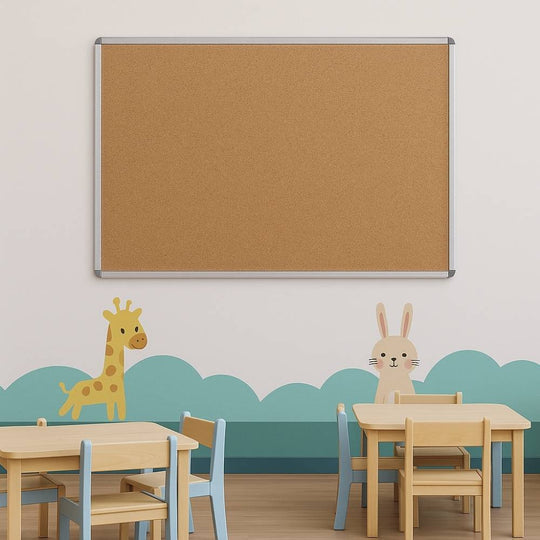
Cork is the standard classroom pin board surface for displaying student work, timetables, and reference materials. The self-healing surface withstands the daily pin-and-remove cycle of active classroom use for years without visible surface degradation. Our 1200x900mm and 1800x1200mm boards suit standard classroom wall positions. Large-format 2400x1200mm boards suit staff rooms where a single full-width board serves as the primary communication display for a department or teaching team. PO accepted from state schools, academies, and independent schools on 30-day credit terms.
For Offices and Professional Environments
Wood-framed cork noticeboards provide a natural material appearance appropriate for professional office environments, boardrooms, and meeting rooms where an institutional aluminium frame would not suit the interior. Our standard 900x600mm and 1200x900mm wood-framed boards suit desk-adjacent and meeting room wall positions. Cork's neutral natural colour works with any office colour scheme without the departmental colour-coding commitment required when choosing felt noticeboards in blue, grey, or red.
For Fire Escape Routes and Corridors
Standard cork noticeboards are not rated for use in fire escape routes, stairwells, and corridors under BS EN 13501-1 Class B building regulations. For these positions, see our fire-rated noticeboards range with Class B certified fabric. This requirement applies regardless of whether the noticeboard surface is cork, felt, or any other material: the surface must carry the Class B fire rating for all corridor and escape route installations in schools, hospitals, and public buildings.
Institutional Reliability:
The Displaysense Advantage
Displaysense has supplied cork noticeboards to schools, universities, NHS trusts, and office environments across the UK for nearly 50 years. We build with high-density natural cork and reinforced fibreboard backing to prevent warping on large-format boards, and use anodised aluminium frames that do not rust or require maintenance. Whether you are outfitting a single classroom or a complete university campus, we offer commercial-grade quality with volume purchase options and purchase order credit terms for all public sector organisations.
For fire-rated corridor noticeboards, lockable secure display cases, and the full institutional noticeboard range, see our noticeboards collection and lockable noticeboards. For complementary display formats see our lockable poster cases.
How to Choose
How does the self-healing surface on a cork board work?
Are cork noticeboards suitable for school corridors and escape routes?
What is the difference between cork and felt noticeboards?
Will a large cork noticeboard warp over time?
Ready to Buy
What types of pins can I use on a cork noticeboard?
Can I mount the same board in portrait or landscape orientation?
Do you accept Purchase Orders from schools, NHS trusts, and universities?
Shop Cork Noticeboards
Designed in the UK. Built in our own factories worldwide. Delivered nationwide.
