


Led Lightbox Display Buying Guide UK 2026

Choose an LED lightbox by working backwards from where it goes and how far away people see it, then match five specifications to that: single or double sided, format size, profile depth, graphic system and frame material. Most buyers pick on size and price and get a unit that lights up but looks ordinary. The professionals who get consistently sharp results settle those five decisions first, because every one of them costs nothing to get right at the point of ordering and is expensive to fix afterward. This guide works through each in turn.
A lit graphic that ripples, bands or glows the wrong colour tells a professional audience "budget" before they have read a word of it. The specification is what separates a display that lifts the space around it from one that undercuts it.
Which Spec Decisions Actually Matter?
Five parameters decide whether a lightbox performs at a professional level. Size and price are the two most buyers focus on. The ones that separate a sharp installation from an ordinary one are profile depth, graphic type, colour temperature and frame material, and all four are settled at the point of ordering.
Work through them in this order before you open a single product listing.
- Where is it going, and how do people approach it? This decides single or double sided. Against a wall, window or stand back panel is single sided. Open floor with traffic on both sides is double sided.
- What format size do you actually need? Work from viewing distance, not floor space. At 5 metres an 850mm unit reads as a poster and a 2000mm unit reads as a brand statement. Across a hall, only 3000mm stops someone mid stride.
- What profile depth does that size require? Depth and format are linked. At 850mm and 1000mm an 80mm profile is fine. At 2000mm and 3000mm you need 120mm to light the face evenly without hot spots.
- What graphic system does the frame use? Silicone edge graphics or snap in backlit print. For anything public facing, specify silicone edge graphics. The taut, frameless finish is in a different class.
- Aluminium frame or PVC frame? Aluminium is the right, cost effective choice to 1000mm. For 2000mm and 3000mm, PVC gives the rigidity and finish aluminium cannot hold at that scale.
What Is the Difference Between 80mm and 120mm Profiles?
Profile depth is the distance from the front face of the lightbox to the back panel, which is also the distance between the LEDs and the graphic. That gap decides how evenly the light spreads before it reaches the surface.
LEDs are point sources. Up close they create a visible hot spot. Give them room to spread and blend before the graphic and the result is even, seamless light. Too shallow a profile for the format, and you get banding, dim edges or visible LED positions through the material.
The standard aluminium specification. Even light to 1000mm, with edge dimness a risk above that. Right for retail point of sale, smaller stands and reception signage.
The premium PVC specification, 50 percent deeper than 80mm. Even across the full face at large format with no hot spots. Right for exhibition backdrops, brand walls and centrepieces.
What Is SEG, and Why Does It Matter?
SEG stands for silicone edge graphics. The graphic is printed on a backlit fabric with a flexible silicone bead bonded around its whole perimeter. That bead slides into a groove machined into the frame, pulling the fabric taut across the full face.
The result is nothing like snap in graphics. No frame around the edges, no rippling or sag in the centre, no shadow lines from the mounting. The graphic sits flat, taut and seamless, as if the image floats in the frame. Under LED light the effect is striking.
Lower cost per graphic change and quick to swap in the field, but with a visible frame around the edge and a risk of bowing under heat or humidity. Acceptable for standard retail and event use.
Taut, frameless and seamless, with no rippling, sag or visible mounting, and a premium finish under LED light. Fire retardant as standard in the premium PVC range. The right call for any high visibility installation.
On a lit lightbox, the single most visible quality indicator is the graphic system. A sagging or rippled snap in print under LED light reads as budget to anyone who knows displays. Silicone edge graphics do not. If a client has invested in a premium stand or a high end fit-out, the graphic system needs to match that ambition, and then nobody asks why the display looks cheaper than the space around it.
Should You Specify Single Sided or Double Sided?
Position and traffic flow decide this entirely, and neither option is better in the abstract. Get it wrong and you either pay for light nobody sees or show an unlit back panel to half your audience.
The back is against a wall, window or stand back panel, traffic only ever approaches from one direction, the display faces outward from a window, or the stand is an inline shell scheme with a back wall.
The unit sits in open floor with aisle traffic on both sides, on an island stand with no back wall, as a lobby or retail centrepiece, or whenever you are unsure and want the most positioning flexibility.
How Much Light and What Colour Temperature Do You Need?
Three things decide whether a lightbox looks premium or looks like a budget product that happens to glow: colour temperature, lumen output and even distribution.
At 6500K colours render as they do in natural light, so blues stay blue and reds stay red. Warm white at 2700K to 3200K shifts everything toward yellow and flattens brand colour. Use warm white only for a deliberate ambient effect.
The premium range runs 590 lumens per bulb at a 72W total draw for the straight unit. That is enough to stay clear and vivid across a busy hall or a high ambient retail space without washing out.
Lumen figures only matter if the light is even. A deep enough profile gives the LEDs room to blend fully before the face, so brightness is consistent edge to edge rather than a bright centre with dim corners.
Can LED Lightboxes Be Connected Into a Continuous Wall?
Yes, if the lightbox is designed for it and ships with the cabling. A single 1000mm unit is a strong point of sale presence. Three connected become a 3 metre brand wall, and four become a 4 metre exhibition backdrop that fills a 3 by 3 metre stand with light. Modular configuration is one of the most underused capabilities in the category.
The question to ask is whether your chosen unit includes inter unit cabling as standard, because many do not. The premium PVC straight range ships with enough cabling to power the unit and connect it to the next, so a continuous wall goes up without sourcing extra hardware on site.
The most common modular setup exhibition companies use is three 1000mm units connected into a 3 metre back wall on a single feed. For brand walls in retail and hospitality, a single large format unit at 2000mm or 3000mm is more common, because one continuous panel removes the join lines a multi unit run creates. Both are right, for different briefs. Know which your project needs before you order.
When Should You Choose PVC Over Aluminium?
This is not a quality either or. Aluminium is the correct specification for standard sizes, lightweight and durable at 850mm and 1000mm. The step up to PVC is necessary, not optional, at 2000mm and 3000mm.
At large widths, the forces on an aluminium frame during assembly, transport and repeated use exceed what a standard extrusion holds over time. Slight warping opens a gap between the profile groove and the silicone edge, which slackens graphic tension. PVC keeps its rigidity through more stress cycles, holds its geometry, and presents a white finish aluminium cannot match at that scale.
| Parameter | Standard aluminium | Premium PVC |
|---|---|---|
| Profile depth | 80mm | 120mm |
| Format widths | 850mm, 1000mm | 2000mm, 3000mm |
| Unit height | 2000mm | 2250mm |
| Rigidity at large sizes | Limited above 1000mm | Exhibition grade throughout |
| Graphics system | Backlit material | Fire retardant silicone edge fabric |
| Light distribution | Even to 1000mm wide | Even to 3000mm wide |
| Internal transformer | Yes | Yes |
| Modular connectivity | Not standard | Cabling included |
| Transport | Standard packaging | Wheeled padded bag included |
| Assembly | Tool free | Tool free, numbered push fit |
| Best for | Retail POS, standard stands | Large brand walls, centrepieces |
Which Lightboxes Does Displaysense Offer?
A standard aluminium range at 850mm and 1000mm, and a premium PVC range at 2000mm and 3000mm. Backlit or silicone edge graphics printing is included, delivery is free to UK mainland addresses, and volume pricing applies from three units.

Lit on both faces. 80mm profile, 6500K, backlit graphics included, in a compact footprint for aisle facing stands and freestanding retail positions.
View Lightbox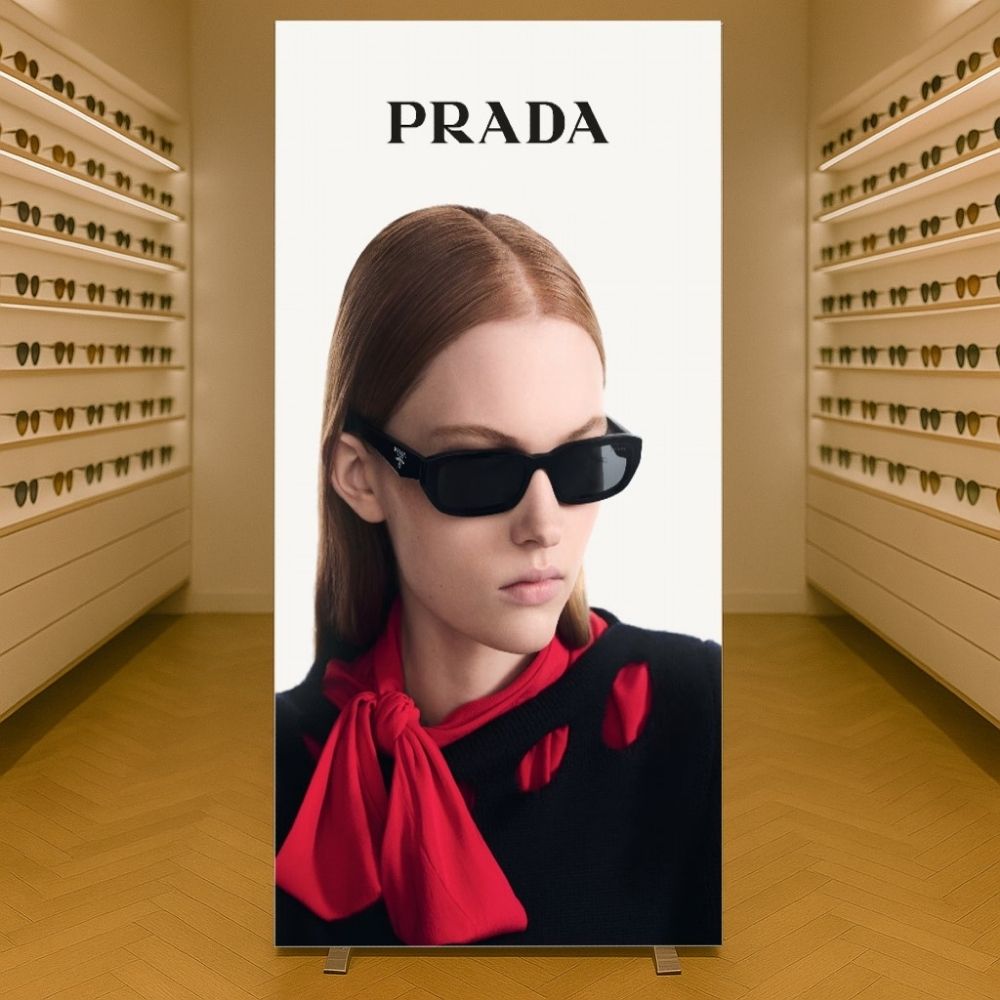
For walls and windows. 80mm profile, 6500K, single face, backlit graphics included, in a compact footprint for tighter positions.
View Lightbox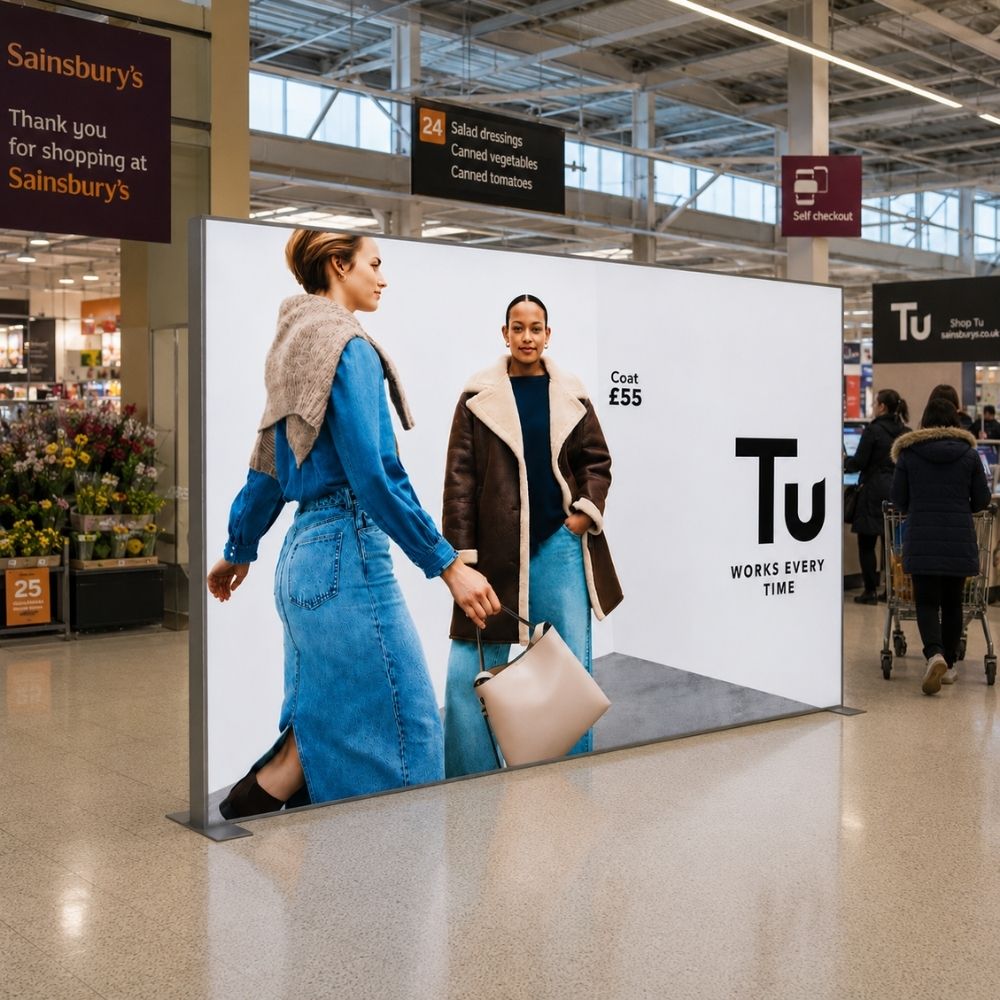
A 3 metre wall in one panel. 120mm profile, 2250mm tall, 590 lumens per bulb at 6500K, fire retardant silicone edge graphics, modular cabling included, 5 year guarantee.
View LightboxBrowse the full LED and illuminated signs range, which also includes the 850mm double sided unit, the single sided 2000mm and the curved premium PVC lightbox at 2000mm and 3000mm. For related retail display, see POS supplies.
What Makes the Premium PVC Range Different?
Bigger format, deeper profile, heavier gauge frame, fire retardant silicone edge graphics, numbered tool free assembly, an internal transformer so no power pack sits on the floor, modular cabling included and a wheeled padded bag as standard. These are not features bolted onto a standard lightbox. They are the specification of a product built to perform a level above the standard range.
Which Lightbox Suits Your Sector?
The same specifications map onto different jobs depending on where the display works and who walks past it.
What Should You Check Before You Order?
Run through this before finalising any lightbox order.
Displaysense supplies LED lightboxes to exhibition companies, retail groups, hospitality and healthcare across the UK, from standard 850mm and 1000mm aluminium units to premium PVC curved and straight lightboxes at 2000mm and 3000mm. Backlit and silicone edge graphics are included, delivery is free to UK mainland addresses, and volume pricing applies from three units.
How Does Volume and Trade Buying Work?
Displaysense supplies LED lightboxes to exhibition companies, event organisers, retail groups, hospitality companies, healthcare trusts and interior designers. Volume pricing applies from three units, with further discounts at five. For project scale orders needing artwork coordination, phased delivery or site specific variations, the sales team can advise on modular planning, cabling and artwork across multiple units.
Public sector buyers, including NHS trusts and councils, can also apply for a credit account and pay on an official purchase order, subject to approval. Call 01279 460 460 or use the contact page.
Choose an LED lightbox by working backwards from position and viewing distance, then settle five specifications. Single sided against a surface, double sided in open floor, and double sided if unsure. Size by how far away people see it. Match profile depth to format, 80mm to 1000mm and 120mm for 2000mm and 3000mm, or large graphics band and dim at the edges. Specify silicone edge graphics for anything public facing, since the taut, frameless finish reads as premium where snap in print reads as budget. Confirm 6500K daylight, not warm white, so brand colours stay true. Choose aluminium to 1000mm and PVC above it for rigidity and finish. If you are building a continuous wall, confirm modular cabling is included before you order.
Frequently Asked Questions
What is the difference between 80mm and 120mm lightbox profiles?
What is SEG and why does it matter?
How much light output do you need for an exhibition?
Can LED lightboxes be connected together?
When should you choose PVC over aluminium?
Why does colour temperature matter for commercial display?
Where can I buy an LED lightbox display?
Dimensions, lumen output, wattage, profile depths and guarantee terms are taken from current Displaysense product pages for the standard and premium PVC lightbox ranges and can change, so confirm on the individual product page before ordering. Fire retardant refers to the silicone edge graphics supplied as standard with the premium PVC range; where a venue sets a specific fire classification, confirm the requirement with the venue and the current product specification before you order. Colour temperature and lumen guidance reflect general commercial display practice for indoor use.

Formats, frames and where each type of poster display works best.
Profiles, mounting and the right snap frame for each job.

Lighting, layout and display choices that stop people mid stride.
