


25 School Display Cabinet Ideas to Inspire Students

25 Creative School Display Cabinet Ideas That Inspire Students
The best school display cabinet ideas give pupils something of their own to find in the glass: their artwork, their team, their name, their year group's project. Below are 25 ideas grouped by the spaces schools actually have, from reception and corridors to art rooms, science blocks, libraries, sports halls and sixth form areas. Take the ones that suit your school, and treat the rest as a prompt for what your cabinets could be doing instead of holding the same dusty cups they have held since 2009.
A display that never changes stops being noticed within a fortnight. Pupils look when they recognise a name or a face, and they look again when something has changed.
Why Do School Display Cabinets Matter?
Because a cabinet is one of the few places in a school where its values, and the pupils who live up to them, are made physical, public and permanent. A display is not decoration. It is the school telling everyone who walks past what it thinks is worth noticing, and pupils read that message whether or not anyone meant to send it.
The Department for Education's Behaviour in schools guidance makes a related point about culture rather than about cabinets. A school's culture and values show themselves through the behaviour of everyone in it, and the standards a school sets should reflect those values. A display case is one of the simplest ways to move values out of the policy document and onto a wall pupils pass every day, and to recognise the people who demonstrate them.
An assembly lasts twenty minutes. A cabinet keeps a pupil's name, work or team in front of the whole school for a term, and in front of their parents at parents' evening.
What a school chooses to put behind glass is a statement of what it values. A case full of sport says one thing; a case that also holds art, music, reading and kindness says another.
Destinations, alumni and pupil work show younger pupils a version of themselves a few years ahead. That is difficult to teach and easy to display.
Parents, governors and inspectors form an impression in the first two minutes, usually while waiting in reception. Objects do that job better than any leaflet.
How Can Schools Use a Display Cabinet in Reception?
Reception is the display everyone sees and nobody plans. It is read by prospective parents, visitors, governors and inspectors, often while they wait, so it is worth more thought than a shelf of cups. Aim for something that says what the school is like, not just what it has won.
- A "this is us" values caseBuild the display around the school's values rather than its trophies. A photograph and a short line for each value, showing pupils actually doing the thing, tells a visitor more in ten seconds than a prospectus does in ten pages.
- This term at a glanceA single case that changes every half term, holding the trip that just happened, the production coming up and the charity total so far. It gives reception a reason to be looked at twice and it is the easiest display in the school to keep current.
- Headteacher's awardsA small, high-status case for the pupils recognised this half term, with their work rather than just their names. It costs nothing to fill and it is the display pupils most often bring their parents to see.
Reception displays live or die on lighting. A wall mounted cabinet with integrated LED spotlights keeps the floor clear for the visitor queue while making certificates and glass actually read from a few metres away.
What Should Schools Display in a Trophy Cabinet?
Trophy cabinets are where schools most often default to habit. Everything in, tallest at the back, done. A few small changes turn the same silverware into a display pupils stop at, and our school trophy cabinet buying guide covers the sizing and shelf loading side of it.


Give each house a bay and let the standings move through the year. The cabinet becomes a scoreboard, and pupils check a scoreboard.
One team, one shirt, one photograph, one paragraph. Far more powerful than fifteen cups nobody can attribute to anyone.
Pair the cups with the names and years, so a pupil can find the sibling, the parent or the teacher who won it. That is what makes people look twice.
A small changeable panel inside the case, updated weekly. It turns a static trophy display into something with news in it.
How Can Art Departments Use Display Cabinets?
Art departments produce the one thing display cabinets are genuinely best at holding, which is three dimensional work that cannot go on a noticeboard. Ceramics, sculpture, textiles and models all need protecting and lighting rather than pinning.

One year group per half term, named and dated like a real exhibition. The rotation is the point, because every pupil gets a turn at some stage.
Set the shelves close and light from above. Small ceramic pieces disappear on a deep, dim shelf and look extraordinary on a shallow, lit one.
A single pupil, their piece, their influences and a few lines in their own words. It reads like a gallery label and pupils take it seriously because of that.
What Should Schools Display in STEM Cabinets?
STEM work is usually the most interesting thing in the building and the least displayed, because it is awkward. Prototypes are fragile, specimens need protecting, and half of it is too delicate for an open corridor. A locked glass case solves all three problems at once.

- Prototype and process displayShow the failed versions next to the finished one. The sketch, the first attempt, the broken one, the final piece. It teaches iteration better than any poster about iteration, and it gives pupils permission to get things wrong.
- Specimen and model caseFossils, rock samples, anatomical models and older equipment from the prep room. Most science departments have a cupboard of genuinely fascinating objects that nobody has seen for fifteen years because there was nowhere safe to put them.
- Competition entriesThe robotics build, the bridge that took the most weight, the egg that survived. Display them with the numbers, since the measurements are what make it competitive and repeatable next year.
How Can Schools Display Their History and Heritage?
Almost every school has an archive, and most of it is in a box in a store cupboard. Museums keep objects like these in enclosed cases to reduce handling, keep dust off and protect them from accidental damage, and the same reasoning is exactly why a school archive belongs behind glass rather than on an open shelf.
Founding documents, the first photograph, an old uniform, a punishment book if you are brave. Pupils are far more interested in their own school's history than in anyone else's.
One shelf per decade, one object per shelf. The change in the uniform alone does more teaching about social history than a worksheet.
Many local museums and archives lend objects to schools. A lockable, glazed case is usually the condition of the loan, so having one already fitted opens the door to it.
Archive material fades. Keep heritage cases out of direct sunlight, since UV is what yellows paper and fades photographs and ribbons over a school year, and use cool running LED lighting rather than anything that puts heat into the case.
How Can School Libraries Use Display Cabinets?
Libraries already do displays well, but a cabinet lets a librarian show the things that cannot be left out on a table, such as signed copies, rare editions, artefacts that go with a book, or the reading trophy that would otherwise walk.
The pupils who read the most this term, with what they read. Recognition works in libraries exactly as it does in sport, and it is rarer, so it lands harder.
A first edition, a signed copy or a letter from a visiting author, with the books alongside. It gives the display a centrepiece that cannot sit on an open shelf.
Recommendations from across the whole staff body, not just teachers. Pupils are genuinely curious about what the site team and the office read.
What Should Music and Drama Departments Display?
Music and drama are the departments whose work vanishes the moment it finishes. A cabinet is the only way to make a performance visible for longer than the night it happened.
An instrument, the ensembles that use it and how a pupil joins. Recruitment for the orchestra, disguised as a display, sitting exactly where pupils queue.
The programme, a costume piece, the poster and a photograph from the night. Put it up the week after and it does more for next year's auditions than an assembly will.
How Can Schools Showcase Alumni and Sixth Form Success?
These are the displays that do the quiet work on aspiration. They matter most where sixth formers and older pupils pass every day, rather than in reception where visitors see them and pupils do not.
- Where our leavers wentUniversities, apprenticeships, employment and training, all given equal billing. A destinations display that only shows universities quietly tells two thirds of the year group that their route does not count.
- Alumni, ten years onFormer pupils and what they are doing now, in their own words. The most effective version includes the ones whose route was not linear, because that is the version most pupils need to see.
How Should Schools Use Display Cabinets at an Open Evening?
An open evening is the one night your displays are doing sales work, and the one night they are competing with a corridor full of parents. Plan for the case to be read from a distance and in a crowd.
Everything a parent asks about, made physical. Uniform, a book from each subject, a trip photograph, the lunch menu. Parents read objects far more readily than leaflets.
One case per department along the tour route, each holding the single most interesting thing that subject does. It gives the tour a rhythm and stops every room looking the same.
What Do These Ideas Look Like in Real Schools?
A few of these ideas as schools have actually built them.

A lit, lockable case in a school reception built around the school's values rather than its silverware, with pupil photographs against each one.

A full-height cabinet given over to house competition, with a bay per house and standings that move through the year.

A corridor cabinet used as a termly exhibition of pupil ceramics and 3D work, lit from above with close shelf spacing.

A design and technology case showing the process rather than the product, with early attempts displayed alongside the finished build.

A heritage display holding the school's own story, positioned away from direct sunlight to protect photographs and paper from fading.
Which Display Cabinets Suit These Ideas?
Most of the ideas above need one of three things: a wall unit where the corridor has to stay clear, a full-height unit for a foyer or hall, or something slim enough to fit a pier between doors.

For corridors, art rooms and reception. Lockable and LED lit at 250mm deep, so a rotating gallery does not narrow the route.
View Cabinet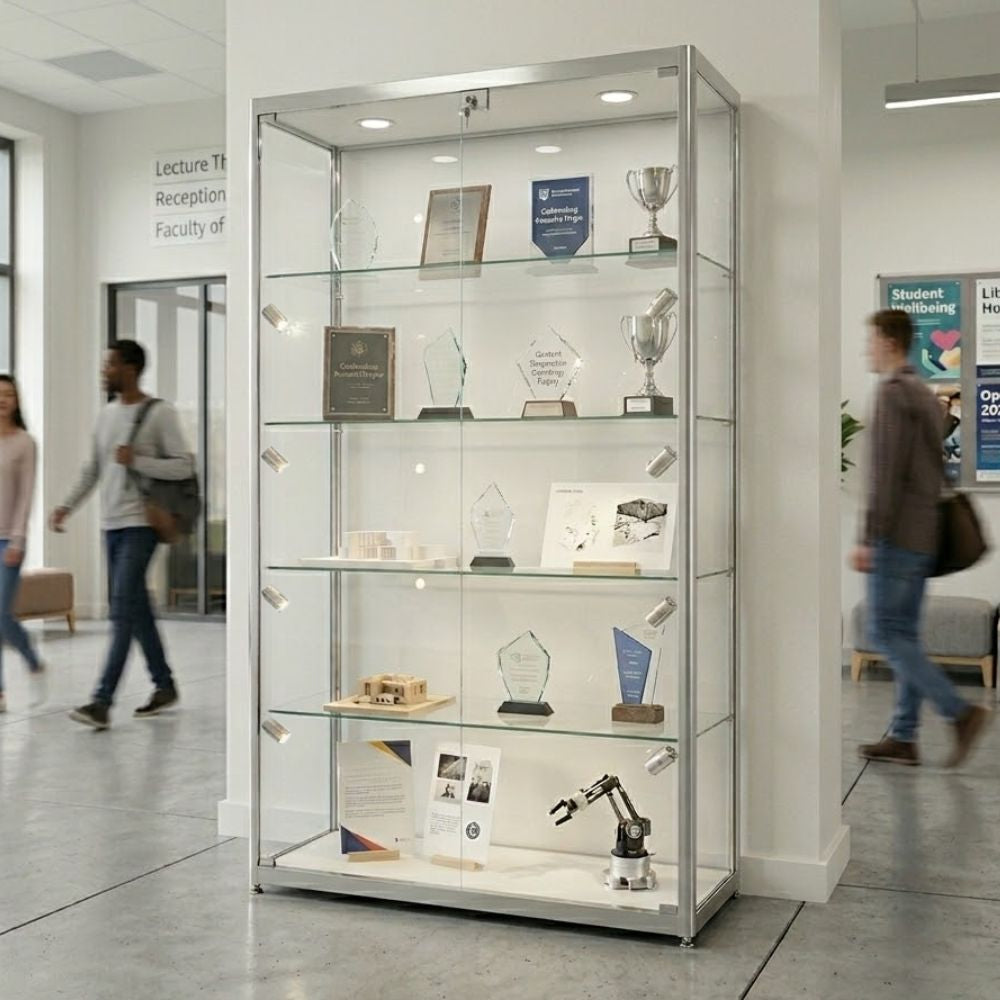
For house standings and foyer displays. Full height, with a lockable base to store the pieces that are out of rotation.
View Cabinet
For subject taster and artist of the month cases. Full height at only 400mm wide, so it fits a pier between classroom doors.
View CabinetBrowse the full display cabinet range, or go straight to trophy cabinets, wall display cabinets, free standing display cabinets and locking display cabinets. For everything else a school needs on its walls, see education display and storage, the noticeboard range and the education hub. If some of these ideas would work better on a board, our display cabinets vs noticeboards guide compares the two.
Displaysense supplies lockable, LED lit and wall mounted glass display cabinets to UK schools, with fire test certification on selected cabinets, free UK mainland delivery, and purchase orders on 30-day credit terms.
The school display cabinet ideas that work share one thing: a pupil can find themselves, or somebody they know, behind the glass. Build reception around values rather than silverware, give trophy cases a scoreboard and some breathing space, and use cabinets for the work that cannot be pinned to a board, meaning ceramics, prototypes, specimens, costumes and archive material. Put destinations and alumni where older pupils walk rather than where visitors do, rotate everything on a termly rhythm, keep heritage and certificates out of direct sunlight, and give every case a named keyholder so it actually changes.
Frequently Asked Questions
What should a school display in a display cabinet?
How often should school displays be changed?
How do you make a school trophy cabinet look good?
What are good display ideas for a school reception?
Where can I buy display cabinets for a school?
Why do school display cabinets need to be out of direct sunlight?

Types, sizing, safety glass, locking and lighting, with a decision tool.

Sizing, shelf loading, locking, lighting and a checklist to run before you order.

Which to use for trophies, pupil work, safeguarding and events, use case by use case.

